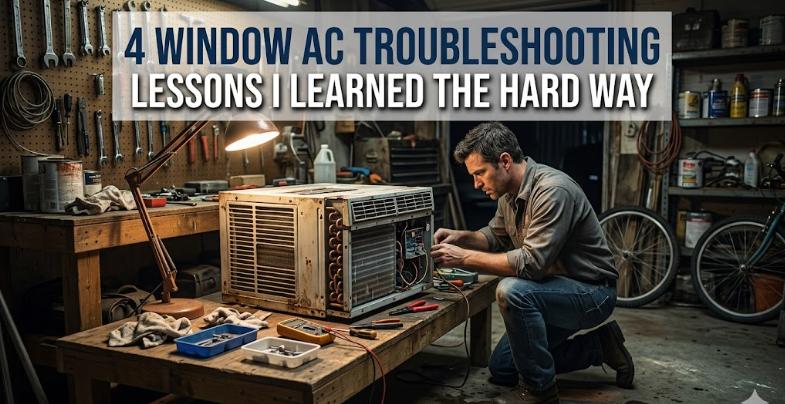
4 Window AC Troubleshooting Lessons I Learned the Hard Way
Introduction
Window air conditioners are one of those household machines you rarely think about until they stop working properly. On a normal day, they quietly hum in the background, keeping your room cool and livable. But the moment something goes wrong, everything suddenly feels uncomfortable, especially in hot weather. Over the years, I learned that most window AC problems don’t happen suddenly. They build up slowly, often because of small issues we ignore.
What makes it worse is that many of us assume AC repair is complicated or only for technicians. I used to think the same way. I would panic at the first sign of trouble, call a repair person immediately, and pay for issues that could have been solved in minutes.
But after a few costly mistakes, I started paying attention. I opened the unit, observed how it works, made small fixes, and slowly understood patterns. What I learned wasn’t just about repair—it was about prevention, observation, and timing.
These are the four biggest troubleshooting lessons I learned the hard way.
Lesson 1: Dirty filters are the root of more problems than you think
The first time my window AC stopped cooling properly, I assumed the gas was low. That’s what everyone says, right? “AC is not cooling? Gas issue.” So I called a technician immediately.
He came, checked the unit, and within 30 seconds pulled out the filter. It was completely clogged with dust. He didn’t even touch anything else. He just washed the filter, reinstalled it, and the cooling improved instantly.
I felt embarrassed—and relieved at the same time.
That moment changed my understanding completely. The air filter is not just a small accessory; it is the first line of defense. When it gets blocked, airflow reduces, cooling drops, and the compressor starts working harder. That leads to higher electricity bills and long-term damage.
What I learned through experience:
- A dirty filter can mimic gas leakage symptoms
- Reduced airflow increases coil freezing risk
- Overworked compressors lead to overheating
Now I clean the filter every two weeks during peak summer. Not monthly. Not “when I remember.” Every two weeks.
I also noticed something interesting. In dusty environments, especially during dry windy days, filters clog faster than expected. Even if the AC is not used heavily, dust still accumulates.
One small habit saved me from repeated service calls. And surprisingly, my electricity bill dropped too.
Lesson 2: Strange noises are early warnings, not just annoyances
For a long time, I ignored unusual sounds from my window AC. A slight rattling here, a buzzing there—I thought it was normal. After all, machines make noise, right?
That assumption cost me.
One summer night, the noise became louder, almost like something was loose inside. I finally opened the front panel and discovered that one of the fan blades had accumulated hardened dust and was slightly bent out of alignment. The imbalance was causing vibration, which was slowly damaging the motor mount.
If I had ignored it further, it could have led to full fan motor failure.
That experience taught me something simple but powerful: noise is communication.
Different sounds mean different problems:
- Rattling: loose screws or panel vibration
- Buzzing: electrical or capacitor issues
- Clicking: relay or thermostat cycling problems
- Whistling: airflow blockage
After that incident, I started treating sound changes like symptoms of illness. The AC “talks” before it breaks completely.
Now whenever I hear even a small change in noise, I inspect the unit immediately. Most of the time, it’s something simple like a loose screw or dust buildup. But catching it early prevents expensive repairs.
Lesson 3: Cooling problems are often airflow problems, not gas issues
This was probably the most expensive lesson I learned.
Whenever my AC stopped cooling properly, my first thought was always “gas is low.” That belief is extremely common. And unfortunately, it leads to unnecessary servicing.
One technician once told me something I never forgot: “Most ACs don’t lose gas often. They lose airflow first.”
I didn’t understand it at the time. But later, I experienced it myself.
My AC was running constantly but not cooling the room. I assumed refrigerant leakage again. But instead of calling immediately, I checked three things:
- Filter condition
- Outdoor unit blockage
- Coil frost buildup
The problem was the outdoor unit. It was partially blocked by dust and a plastic sheet that had shifted during wind. Air could not flow properly, so heat was not releasing outside. That made the indoor cooling almost useless.
Once I cleared the blockage and cleaned the condenser, the cooling returned to normal within minutes.
That’s when I realized:
Cooling depends on balance. If airflow is disrupted anywhere in the system, performance drops dramatically.
Common airflow issues I now check before assuming gas problems:
- Dirty indoor filter
- Blocked condenser coils
- Obstructed outdoor airflow
- Ice formation on evaporator coils
Now I never jump to gas refilling unless everything else is checked first. In most cases, it’s not gas at all.
Lesson 4: Small leaks and moisture signs should never be ignored
This lesson came after a frustrating experience where I ignored a tiny water drip for weeks.
At first, it seemed harmless. Just a small drop near the corner of the AC. I placed a cloth underneath and forgot about it. But over time, the dripping increased. Eventually, water started seeping into the wall.
When I finally inspected it properly, I discovered that the drain pipe was partially blocked with dust and algae buildup. The water that should have flowed outside was backing up inside the unit.
What surprised me most was how quickly this small issue escalated. It wasn’t just water leakage anymore—it had started affecting the wall paint and caused slight rusting inside the metal frame.
That experience taught me that moisture issues are never isolated.
Here’s what I learned to watch for:
- Water dripping from front panel = drainage blockage
- Ice melting inside unit = airflow or temperature imbalance
- Damp smell = microbial buildup inside coils
- Rust marks = long-term moisture exposure
Now I inspect the drain pipe every month during summer. I also flush it with mild water pressure to keep it clear.
It’s a small maintenance step, but it prevents structural damage and mold growth.
Bonus insight: Most AC problems are interconnected
After years of dealing with AC issues, I realized something important: problems rarely exist alone.
A dirty filter can cause:
- Low airflow
- Ice formation
- Water leakage
- Compressor strain
A blocked condenser can cause:
- Poor cooling
- Overheating
- High electricity consumption
One small issue can trigger a chain reaction. That’s why quick diagnosis matters more than quick fixing.
Instead of reacting to symptoms, I now trace the root cause.
A simple mental checklist helps:
- Is airflow normal?
- Is the outdoor unit clear?
- Is there ice or moisture buildup?
- Has noise changed recently?
This approach saves both time and money.
Conclusion
Window AC troubleshooting is not about being technically perfect. It’s about being observant. Most of the problems I faced in the past weren’t complicated failures—they were simple issues that grew because I ignored early signs.
The biggest shift in my understanding was realizing that an AC rarely “breaks suddenly.” It gives warnings—low cooling, unusual sound, dripping water, or weak airflow. If you pay attention early, you can avoid most repairs entirely.
These lessons didn’t just save me money. They made me more confident in handling basic home maintenance without panic.
And the truth is, once you understand how your window AC behaves, it stops being a mysterious machine and becomes something predictable and manageable.
FAQs
- Why is my window AC running but not cooling properly?
Most of the time, it is due to dirty filters, blocked airflow, or a clogged condenser rather than gas leakage. Always check airflow first. - How often should I clean my window AC filter?
During heavy summer use, every 2 weeks is ideal. In lighter use, once a month may be enough. - What causes water leakage from a window AC?
The most common cause is a blocked drainage pipe or improper unit tilt, which prevents water from flowing out properly. - Why does my AC make a rattling noise?
Rattling usually indicates loose screws, dust buildup on fan blades, or slight misalignment of internal parts. - Is gas refilling necessary every year?
No, AC gas does not get used up under normal conditions. If gas is low, it usually means there is a leak that needs fixing. - Can I fix AC problems myself or should I call a technician?
Basic issues like cleaning filters, checking drainage, and clearing external blockage can be done at home. For electrical or compressor issues, a technician is safer.