4 Easy Window AC Installation Fixes I Learned the Hard Way
There’s a certain kind of confidence that comes with installing a window AC unit for the first time. You watch a couple of videos, skim through the manual, and think, “How hard could it be?” That was exactly my mindset the first time I attempted it. Within a few hours, that confidence turned into frustration, sweat, and a room that was somehow warmer than before I started.
What I didn’t realize back then is that installing a window AC is less about brute effort and more about precision. Small mistakes don’t just reduce cooling efficiency—they quietly increase electricity bills, shorten the unit’s life, and sometimes even create safety risks. Over time, through trial, error, and a few regrettable shortcuts, I learned a handful of fixes that made a dramatic difference.
This isn’t just a list of tips. These are lessons learned the uncomfortable way—through noise complaints, water leaks, and a unit that nearly slipped out of the window one afternoon. If you’re planning to install or improve your window AC setup, these four fixes will save you time, money, and a fair bit of stress.
fix 1: correcting the tilt – the mistake that caused indoor rain
The first time I installed my window AC, I was obsessed with making it look perfectly straight. I even used a level to ensure it was aligned evenly with the window frame. It looked great—symmetrical, clean, and professional.
What I didn’t know was that a perfectly level AC is actually a problem.
Within a day or two, I noticed something odd. Water started dripping from the front panel—inside the room. At first, I thought it was condensation from the humid air. Then the dripping turned into a steady trickle, and suddenly I had a small puddle forming near the wall.
The issue was simple but not obvious: the AC unit needs a slight downward tilt toward the outside. This allows the condensation that forms during cooling to drain properly. Without that tilt, water collects inside and eventually spills back into the room.
Fixing it required removing the unit and reinstalling it with a slight backward slope. Not dramatic—just enough that gravity does its job. Most manufacturers recommend a tilt of about half an inch to an inch toward the outside.
After making that adjustment, the dripping stopped immediately. The unit also seemed to run more quietly, likely because water wasn’t pooling around internal components.
This experience taught me something important: not every installation detail is about appearance. Some things are designed to look slightly “off” because that’s what makes them function correctly.
fix 2: sealing the gaps – where all the cool air escaped
After solving the water issue, I expected perfect cooling. Instead, the room still felt inconsistent. The AC was running, but the temperature barely dropped. It felt like trying to cool a room with the windows open—which, as it turns out, was almost exactly what was happening.
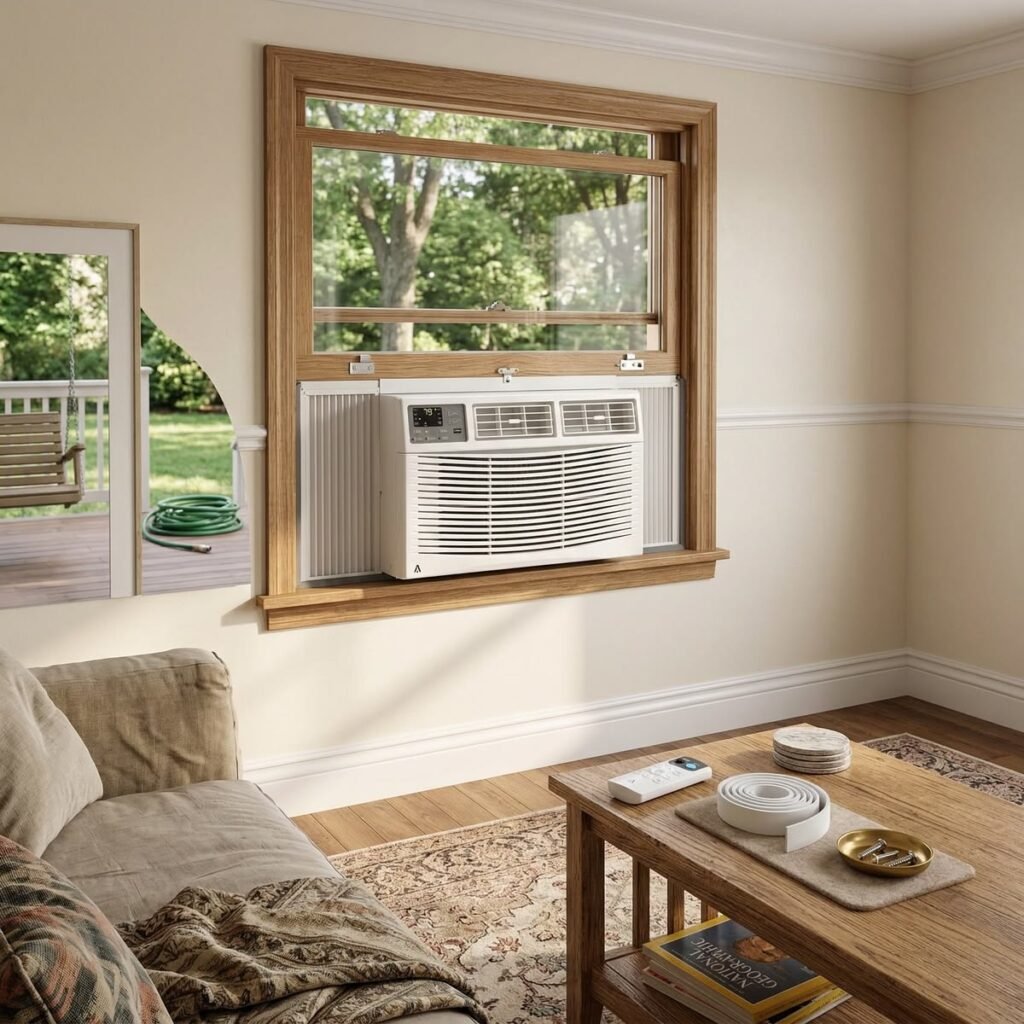
When I inspected the installation more closely, I noticed small gaps around the sides of the unit. The accordion panels didn’t fully seal the window frame, and there were tiny openings along the top edge as well.
At first glance, these gaps seemed insignificant. But air doesn’t need much space to move. Cool air was escaping, and warm air from outside was sneaking in. It created a constant battle that the AC could never win.
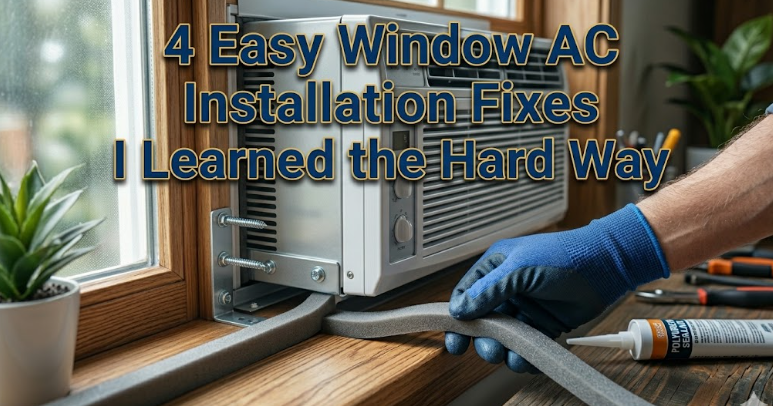
The fix was straightforward but required attention to detail. I used foam insulation strips to fill the gaps and weather sealing tape to cover the edges. In some spots, I added a second layer just to be sure there was no airflow.
The difference was immediate. The room cooled faster, the AC cycled off more often instead of running continuously, and the overall comfort improved noticeably.
This was also the moment I realized how much energy I had been wasting. That small oversight had likely been costing me money every hour the unit was running.
Sealing gaps isn’t glamorous, but it’s one of the most impactful things you can do. It turns your AC from a struggling appliance into an efficient system.
fix 3: stabilizing the unit – the day it almost fell
One afternoon, I heard a strange rattling noise coming from the window. It wasn’t the usual hum of the AC—it was sharper, more irregular. When I checked, I noticed the unit had shifted slightly forward.
That was the moment it hit me: the AC wasn’t properly supported.
I had relied entirely on the window frame to hold the unit in place. While it seemed secure initially, the constant vibration from the compressor had gradually loosened its position. Add a bit of uneven weight distribution, and the entire unit started leaning outward.
This wasn’t just a performance issue—it was a safety hazard. A falling AC unit can cause serious damage or injury.
The fix involved installing a proper support bracket underneath the unit. These brackets are designed to hold the weight of the AC from the outside, reducing strain on the window frame. Once installed, the difference was obvious. The unit felt solid, stable, and far less noisy.
I also tightened all the mounting screws and checked the alignment again. With proper support, the AC operated more smoothly and quietly.
This experience reinforced a simple principle: if something is heavy and sits partially outside your home, it needs more than just hope to stay in place.
fix 4: choosing the right power setup – the hidden electrical problem
For the first few weeks, my AC worked fine—until it didn’t. One evening, it suddenly shut off. I assumed it was a temporary issue, but then it happened again. And again.
After some investigation, I realized the problem wasn’t the AC itself—it was the power source.
I had plugged the unit into a standard extension cord. It seemed convenient at the time, but it wasn’t designed to handle the high power load of an air conditioner. The cord would heat up slightly, and the voltage drop caused the unit to shut down intermittently.
This was more than an inconvenience—it was a potential fire risk.
The fix was to plug the AC directly into a dedicated wall outlet. If that’s not possible, using a heavy-duty extension cord rated for high wattage is essential. Even better is ensuring the outlet is on a circuit that can handle the load without interference from other appliances.
Once I made this change, the shutdowns stopped completely. The AC ran consistently, and I no longer worried about overheating wires behind the scenes.
It’s easy to overlook the electrical side of installation, but it’s just as important as the physical setup. A stable power supply ensures not only performance but also safety.
bringing it all together
Looking back, none of these fixes were complicated. They didn’t require advanced tools or professional expertise. What they did require was awareness—an understanding that small details can have big consequences.
Each mistake taught me something valuable. The tilt taught me about drainage. The gaps revealed how sensitive cooling systems are to airflow. The unstable unit highlighted the importance of structural support. And the power issue reminded me that electricity deserves respect.
Together, these lessons transformed the way I approach not just AC installation, but any kind of home setup. It’s not about doing things quickly—it’s about doing them correctly.
There’s also a certain satisfaction that comes from fixing these issues yourself. Once everything is properly installed, the difference isn’t just measurable—it’s محسوس. The air feels cooler, the room feels quieter, and there’s a sense of confidence in knowing the system is working as it should.
frequently asked questions
- how much tilt should a window ac unit have
A slight tilt of about 0.5 to 1 inch toward the outside is usually enough. The goal is to allow condensation to drain properly without affecting the unit’s balance. - what is the best way to seal gaps around a window ac
Foam insulation strips, weather sealing tape, and properly adjusted side panels work best. The key is to eliminate any path for air to move in or out. - do i really need a support bracket for my window ac
If your unit is heavy or extends significantly outside the window, a support bracket is highly recommended. It improves safety and reduces strain on the window frame. - can i use a regular extension cord for my ac
No, it’s not advisable. Air conditioners require a high power load. Always use a dedicated outlet or a heavy-duty cord rated for the unit’s wattage. - why is my window ac leaking water inside
This is usually due to improper tilt or blocked drainage. Ensuring the unit is angled slightly outward typically solves the problem. - how do i know if my ac is installed correctly
A properly installed AC will cool efficiently, run quietly, have no water leakage inside, and remain stable without shifting. If all these conditions are met, your installation is likely solid.
In the end, the difference between a frustrating AC experience and a comfortable one often comes down to these small but crucial details. Fix them once, and you’ll feel the impact every single day the temperature rises.