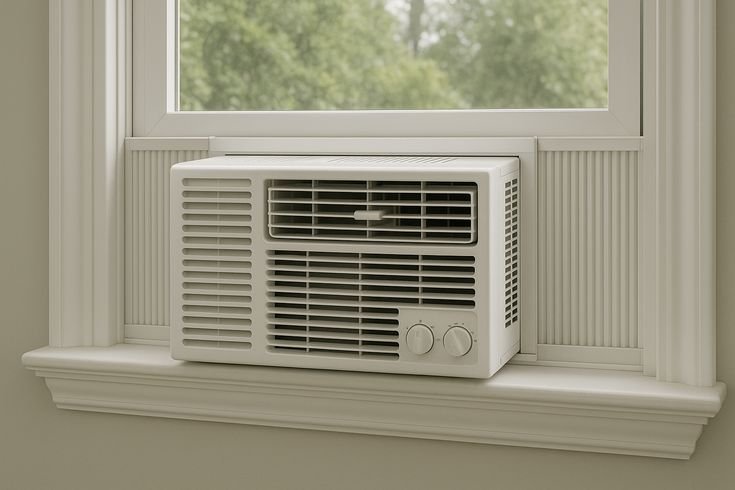
Let me be honest with you — the first time I installed a window AC unit, I was sweating more than I would have been without it. It was a 95-degree Saturday afternoon, I had a brand new 8,000 BTU unit sitting in a cardboard box, and I was absolutely convinced it would take me “maybe 30 minutes.” Three hours later, my unit was rattling like a tin can in a dryer, dripping water onto my windowsill, and blowing air that could barely chill a glass of lemonade.
I made every mistake possible. And over the years — between my own home, helping friends install theirs, and spending way too many evenings on HVAC forums — I’ve seen the same errors repeated over and over.
If you’re about to install a window AC (or you’ve already done it and something feels off), this one’s for you. Let’s get into it.
1. Picking the Wrong BTU for the Room Size
This was my very first mistake, and I see it constantly. People either grab whatever’s on sale or assume “bigger is always better.” Both approaches will leave you miserable.
Here’s the thing — an undersized unit will run nonstop and never actually cool the room. An oversized one will cool too fast, shut off before removing humidity, and leave your room feeling like a cold, damp cave.
A simple BTU guide to get you started:
| Room Size (sq ft) | Recommended BTU |
|---|---|
| Up to 150 | 5,000 BTU |
| 150 – 250 | 6,000 BTU |
| 250 – 350 | 8,000 BTU |
| 350 – 550 | 10,000 – 12,000 BTU |
| 550 – 700 | 14,000 BTU |
| 700 – 1,000 | 18,000 BTU |
But BTU isn’t just about square footage. You also need to factor in:
- Sun exposure — south or west-facing rooms absorb significantly more heat. Add about 10% to your BTU estimate.
- Ceiling height — standard calculations assume 8-foot ceilings. Higher ceilings mean more air volume to cool.
- Kitchen placement — if you’re cooling a kitchen, bump up by at least 4,000 BTU because of cooking heat.
- Number of occupants — add 600 BTU per extra person beyond two.
I installed a 5,000 BTU unit in a 300 sq ft bedroom and wondered why it ran 24/7. The lesson cost me two months of inflated electricity bills.
2. Not Checking the Window Type and Dimensions Before Buying
You’d think this one is obvious. It’s not.
I watched a neighbor buy a brand new unit, get home, and realize his window was a casement-style (the kind that cranks open sideways) rather than a double-hung. Standard window ACs are designed for double-hung windows. Period.
Before you buy anything, measure your window opening — both width and height — with a tape measure. Then check the specs on the box carefully. Most units have an adjustable accordion side panel, but those panels only extend so far. If your window is unusually wide or narrow, you’ll need a different solution.
Quick checklist before purchasing:
- Window type (double-hung, casement, slider, awning)
- Minimum and maximum width the unit supports
- Required window height for proper fit
- Weight of the unit vs. your window frame’s strength
Older homes especially can have non-standard window openings. If your opening is wider than the accordion panels can cover, you’ll need to cut and install a foam insert or a custom wood panel — doable, but better to know upfront than mid-install.
3. Skipping the Tilt — or Tilting It the Wrong Way
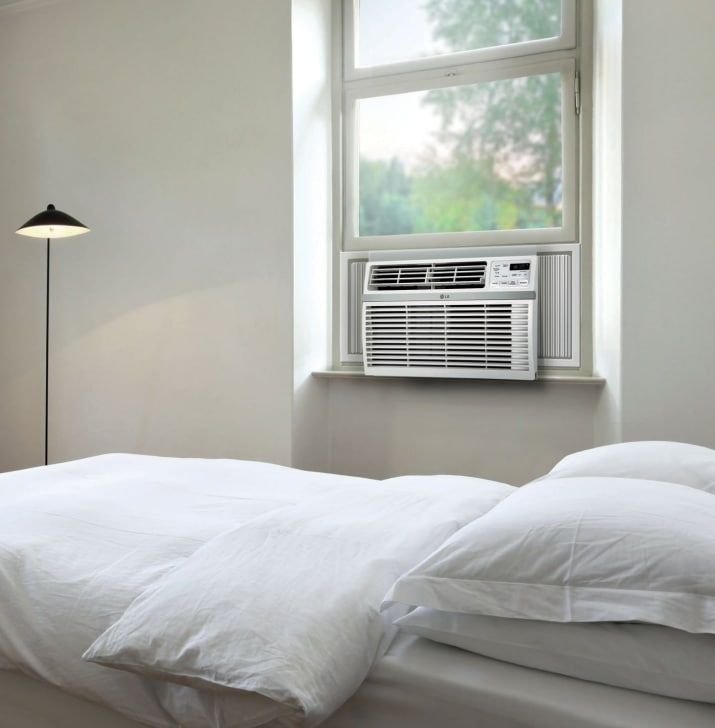
This one is subtle but causes real problems. Every window AC unit needs a very slight backward tilt — meaning the outside end should sit just a touch lower than the inside end. This allows condensation to drain out the back instead of pooling inside or dripping onto your floor or windowsill.
How much tilt? About half an inch to an inch of drop from front to back. That’s it. You don’t need much.
The mistake most people make? They either install it perfectly level (water pools inside), or they tilt it forward slightly thinking the drain hole is at the front (it’s usually at the back or bottom-rear).
How to check the tilt:
Use a simple bubble level. Place it on top of the unit from front to back. You want the bubble to be ever so slightly toward the front — indicating the back is lower. Some units come with a built-in leveling guide in the manual, which is worth reading for your specific model.
If your window sill is perfectly flat and won’t allow for this tilt naturally, use the included bracket (most units come with one) to angle the unit outward slightly. Don’t skip this step. I skipped it once and ended up with a small but persistent water stain on my hardwood floor.
For a deeper look at how installation choices affect your unit’s performance and lifespan, check out 9 Common Window AC Installation Mistakes to Avoid Today — it covers a few additional issues I didn’t even think about until way later.
4. Ignoring the Side Panels and Sealing
Air gaps are your silent enemy. I’m talking about those spaces on either side of the unit where the accordion panels don’t quite seal properly, or where there are gaps between the panel and the window frame.
Here’s what happens when you ignore them:
- Hot outside air sneaks back into the room
- Insects find a lovely little doorway into your home
- Your unit works harder than it needs to, driving up your electricity bill
- In humid climates, moisture comes in and increases the cooling load
After my first summer wondering why my room wasn’t getting as cold as it should, I grabbed a flashlight and checked the sides. I could literally feel warm air flowing in through the gaps.
The fix is cheap and takes 10 minutes:
- Use foam weather stripping tape (available at any hardware store for under $5) around the window frame edges
- For larger gaps in the accordion panels themselves, get a roll of foam AC side panel seal tape — it’s sold specifically for this
- If you have a wider window opening that required a wood or foam filler panel, make sure those are caulked or sealed properly too
Some people also use a window AC insulation kit (like the ones from Frost King) that include foam panels and tape — all pre-cut and ready to go. Worth it if you’re in a hot or humid climate.
5. Overloading the Electrical Circuit
This one has the potential to be genuinely dangerous, not just inconvenient.
Window AC units — especially anything 10,000 BTU and above — draw significant power. Larger units (12,000–18,000 BTU) often require a dedicated 240V outlet. Even “smaller” 8,000–10,000 BTU units on a 120V circuit can trip breakers if they’re sharing that circuit with other high-draw appliances.
I made the mistake of running a 10,000 BTU unit off the same outlet as my desktop computer and monitor. The first time the compressor kicked on and the computer froze mid-game, I realized something was wrong. The breaker tripped twice that first week.
What you should know before plugging in:
| Unit Size | Power Requirement |
|---|---|
| 5,000 – 8,000 BTU | Standard 120V, 15-amp circuit |
| 8,000 – 12,000 BTU | 120V, dedicated 20-amp circuit preferred |
| 12,000 BTU and above | May require 240V dedicated outlet |
| 15,000 – 25,000 BTU | Almost always requires 240V |
Check your unit’s label for its amperage draw. Then check if your outlet and circuit can handle it. If you’re not sure, a licensed electrician can tell you in about 10 minutes whether your current setup is safe — and it’s worth paying for that peace of mind.
Also — and I can’t stress this enough — never use an extension cord with a window AC unit unless it’s a heavy-duty cord rated for the unit’s amperage. Most standard household extension cords are not rated for AC use and can overheat.
6. Not Securing the Unit Properly
Window AC units are heavy. We’re talking anywhere from 35 to over 100 pounds depending on the size. And they’re hanging partially out of your window, supported partly by the window frame and partly by a mounting bracket.
I once helped a friend install a unit and we decided to “just prop it in for now” without using the L-bracket support arm that was included in the box. Two weeks later, during a windy night, the unit shifted outward — caught by the window sash, thankfully, but it was a close call.
Proper installation means:
- Using the included support bracket that extends from the bottom of the unit to the outside wall. This transfers weight away from the window frame.
- Closing the window sash down firmly onto the top of the unit or onto the included top rail, which locks the unit in place.
- Checking that all screws are tightened — accordion side panels typically have holes for screws to anchor them to the window frame. Use them.
- For older or weaker window frames, consider an external AC support bracket (brands like Qualward or Air Conditioner Support make solid ones). These mount to the outside wall and take the weight off the frame entirely.
If you’re on a higher floor or in an area with strong winds, please don’t skip the support bracket. This isn’t just about protecting your unit — it’s about safety for everyone below.
7. Skipping the Test Run and Post-Install Check
Once the unit is in, most people just flip it on and walk away. I did this the first few times and missed problems that would have been easy to fix right then but became annoying later.
After every installation, do a proper test run:
Right after installing:
- Turn it on at the highest fan speed (not cooling yet) and walk around the window frame feeling for air drafts from the sides — seal any you find
- Switch to cooling mode and let it run for 10–15 minutes
- Stand outside and check where the water is draining — it should drip from the back of the unit, not pool on your windowsill
- Listen for unusual rattling or vibration — these usually mean something is loose, either the unit itself or the accordion panels
- Check that the window sash is fully pressing down and nothing has shifted
A week after installing:
- Re-check all screws and fasteners — the weight and vibration can loosen things slightly
- Look for any water staining on the inside windowsill that might indicate improper drainage
- Check your electricity bill if you have a smart meter — a sudden spike might mean the unit is working harder than it should due to an air leak
This 15-minute follow-up has saved me multiple headaches. Once I caught a panel that had partially collapsed inward on a wider installation, completely killing the airflow on one side.
A Few Things That Also Made a Difference
Once I started getting the installation basics right, I found that small habits made a big long-term difference. Things like cleaning the filter every two to three weeks during heavy use, keeping the area around the unit clear for airflow, and checking the coils at the start of every season.
If your unit is struggling even after a proper install, the issue might be simpler than you think. I went through a phase of calling technicians for problems that turned out to be a clogged filter or a blocked drain — both things I could have handled myself with these 5 simple troubleshooting checks you can do at home.
And if you’re noticing your electricity bill creeping up even though the unit seems to be working fine, it’s worth revisiting your installation for air leaks and also checking out 10 smart window AC energy saving tips to reduce electricity bills — some of those tips are surprisingly simple but genuinely effective.
The Bottom Line
Window AC installation looks simple on the surface — you basically just stick it in a window, right? But as I found out the hard way (repeatedly), the details matter. BTU sizing, proper tilt, air sealing, electrical safety, secure mounting — each one of these can mean the difference between an AC that runs efficiently for years and one that drives you crazy all summer.
The good news is that all of these mistakes are avoidable, and most of them are fixable after the fact without too much effort. Go through this list before your next install or use it as a checklist to audit an existing one. Your electricity bill — and your sanity — will thank you.
If you’re setting up a window AC for the first time and want a complete walkthrough, this guide is a great next step: 9 Ultimate Window AC Installation Setup Guide for Beginners