Meta Description: Window AC cleaning & maintenance guide fixes weak cooling fast. Discover 9 proven DIY steps to restore your unit’s power, cut energy bills, and beat the heat.
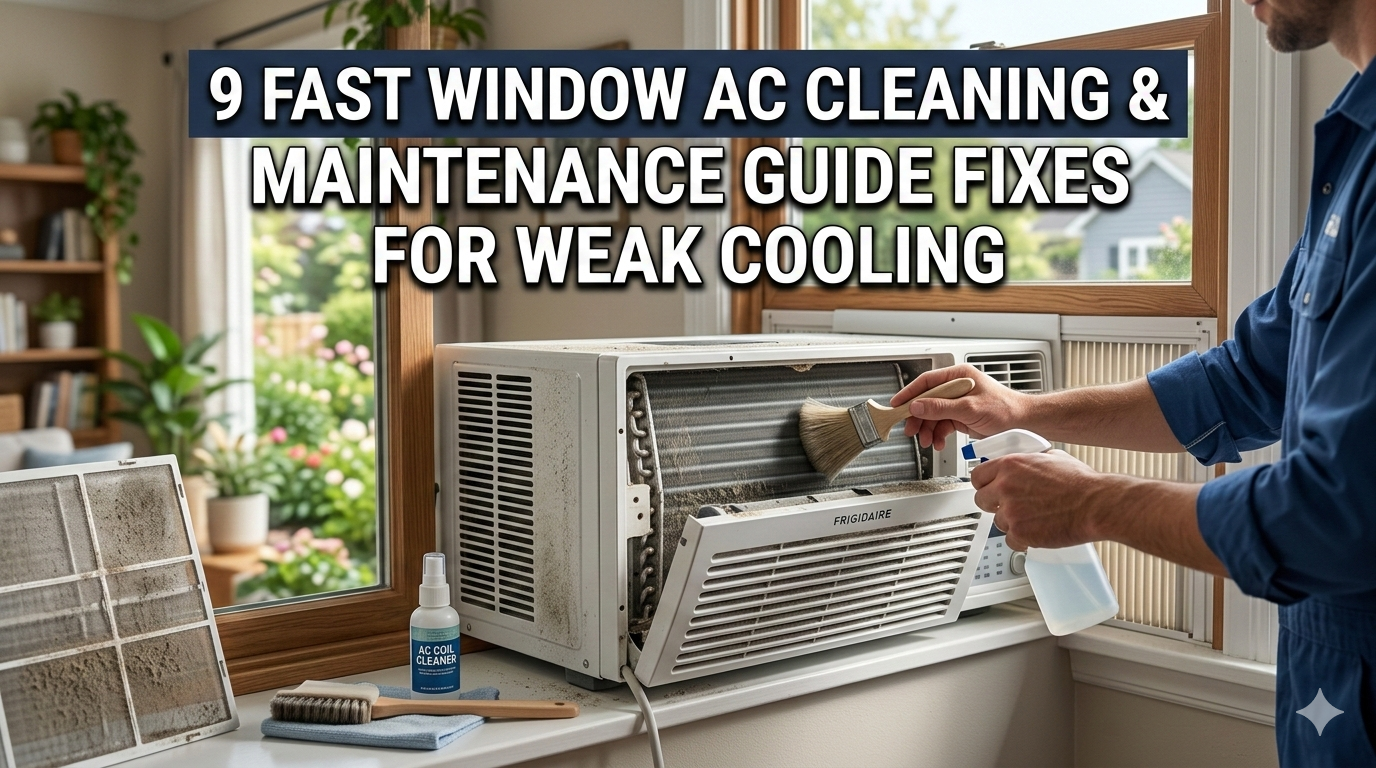
Fix Weak Cooling Fast With Window AC Cleaning & Maintenance Guide
Here are 9 DIY steps that have been proven to restore your unit’s power, slash energy bills and beat the heat.
Is your window AC operating but not cooling much? You’re not alone. Millions of people contend with weak airflow and increasing room temperatures every summer — and most times, the solution is less complicated than you think.
This window air conditioner cleaning & maintenance guide outlines 9 quick, proven fixes that can restore your unit’s cooling power without having to call a technician. Whether your AC is releasing warm air, smelling musty, or simply not working well, these things will help.
Let’s get into it.
Why Your Window Air Conditioner Is Losing Its Cool
It’s worth knowing why window ACs lose cooling power over time before diving into fixes.
The most common culprits are:
- Clogged or dirty air filters
- Blocked condenser or evaporator coils
- Dirty or bent fins
- Low or leaking refrigerant
- Drainage problems
- Improper installation or poor sealing
These are mostly problems that build up over time. Dust, pet hair, mold and debris accumulate in the unit without you realizing it — until one sweltering afternoon when the AC can’t keep pace.
The good news? The vast majority of these are completely fixable at home with common tools and a bit of time.
What You’ll Need Before Getting Started
Collect these supplies before starting any cleaning or maintenance:
| Tool/Supply | Purpose |
|---|---|
| Screwdriver (flathead + Phillips) | Removing panels and covers |
| Soft brush or old toothbrush | Cleaning fins and coils |
| Vacuum with brush attachment | Sucking out dust and debris |
| Coil cleaner spray (no-rinse) | Deep cleaning evaporator coils |
| Fin comb | Straightening bent aluminum fins |
| Mild dish soap + warm water | Washing air filter |
| Spray bottle | Applying cleaning solutions |
| Dry cloth or microfiber towel | Wiping surfaces |
| Gloves and safety glasses | Personal protection |
You don’t need to be a pro. If you are comfortable using a screwdriver and a vacuum cleaner, you can tackle most of these repairs on your own.
Fix #1 — Wash or Get a New Air Filter (If You Do Nothing Else, Do This)
This is the top reason why window ACs blow weak air. A clogged filter restricts airflow and makes the unit work harder while cooling less.
How to do it:
- Switch off and disconnect the AC unit.
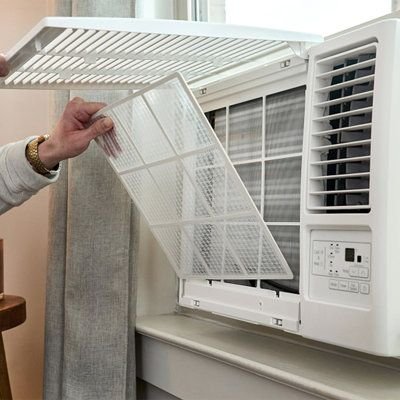
- Pull off or unscrew the front grille.
- Pull the air filter straight out — it tends to resemble a thin mesh screen.
- Hold it up to light. If you can’t see through it clearly, it’s dirty.
- Scrub it out with warm water and a bit of dish soap.
- Rinse well, shake off excess water and allow to air dry completely.
- Reinstall it before you switch the AC on again.
How often: Every 2–4 weeks during peak usage. If it is worn or has holes, replace it every season.
Pro tip: Don’t ever turn on the AC without a filter. Dust will cover the coils themselves and cause even larger issues.
Fix #2 — Vacuum the Inside and Remove Dust
Dust begins to get inside the unit over time, even with a clean filter. Dust buildup inside restricts airflow and makes the entire system work inefficiently.
Steps:
- Unplug the unit and remove the outer casing (typically a handful of screws on the back and sides).
- Use a vacuum with a soft brush attachment.
- Carefully vacuum around the fan blades, coils and inner walls.
- Refrain from pushing too hard on the delicate metal fins — they easily bend.
- Wipe the interior walls with a dry cloth.
This step can help to greatly improve the airflow in a matter of minutes.
Fix #3 — Clean the Evaporator Coils
The indoor-facing coils are the evaporator coils — they are cold and cool the air that is blown through them. When they’re covered with dust and grime, they can’t absorb heat correctly — and your room remains warm.
How to identify dirty coils: They’ll appear gray or fuzzy rather than shiny silver.
How to clean them:
- Unplug the unit and remove the casing to find the front coils (behind where you insert the filter).
- Spray a no-rinse evaporator coil cleaner directly onto the coils.
- Let it foam up and rest for 5–10 minutes.
- The cleaner runs down into the drain pan, taking dirt with it.
- Do not rinse — these products are designed to self-drain.
Why this is important: Clean coils can recover 10–20% of cooling efficiency lost since the previous cleaning.
Fix #4 — Clean the Condenser Coils (Outside)
The condenser coils are on the outside. They give off the heat that was extracted from your room. When they’re clogged with leaves, dirt or cottonwood fluff, your AC can’t dump heat quickly enough — and performance falls fast.
Steps:
- With the unit still unplugged and removed from the window (if feasible), flip it or access the back panel.
- Use a soft brush to gently wipe debris off the outdoor-facing coils.
- Also spray the condenser coils with coil cleaner.
- You can gently rinse condenser coils with water because they’re built to withstand outdoor exposure.
- Let them dry before reassembling.
| Coil Type | Location | Cleaning Method |
|---|---|---|
| Evaporator Coil | Indoor side | No-rinse spray cleaner |
| Condenser Coil | Outdoor side | Brush + rinse or spray |
Fix #5 — Use a Fin Comb to Straighten Bent Fins
Examine both sets of coils closely. You’ll notice thin aluminum strips called fins running along them. Those fins help the air pass over the coils to facilitate heat exchange.
When fins bend — from impacts, pressure or rough cleaning — it restricts airflow. Even with clean coils, bent fins reduce performance.
How to fix bent fins:
- Purchase a fin comb (which can be found online or at hardware stores for less than $15).
- Match the comb teeth to the fin spacing on your unit.
- In a straight, upward motion, slide the comb gently through the bent section.
- Work slowly — fins tear if you hurry.
Straightening bent fins is one of the least-mentioned fixes in any window AC cleaning & maintenance guide. It’s fast, inexpensive, and makes a real difference.
Fix #6 — Clean the Drain Pan and Drain Line
Window air conditioners pull moisture from the air as they cool. That water gathers in a drain pan and drains out through a tiny drain hole or tube. When that drain becomes clogged, water backs up — and what you get is:
- Leak or drip inside the room
- Mold and mildew growth
- Musty smells from the unit
- Reduced cooling efficiency
How to clean the drain system:
- Find the drain pan at the bottom of the unit (within the casing).
- Use a towel or small wet/dry vacuum to remove standing water.
- Wash the pan with warm soapy water and rinse.
- Locate the drain hole (typically a small opening at the bottom back).
- Poke through any blockage with a thin wire or pipe cleaner.
- To kill mold, pour a small amount of diluted bleach (1 part bleach to 10 parts water) into the pan.
Signs your drain is clogged:
- Water accumulating inside or beneath the unit
- Gurgling sounds during operation
- Smell of mustiness or sourness from the vents
Fix #7 — Seal Air Gaps Around the Unit
This one tends to catch a lot of people off guard. Even with a perfectly clean, properly working AC, warm outside air seeping in around the edges will make your room feel warm.
Window AC units have accordion-style side panels that you can extend, as well as foam tape to seal gaps. With time, these will decay, crack or fall away completely.
How to check for leaks:
- On a hot day, run your hand around the edges of the unit.
- Check for warm air blowing in from any direction.
- Check for visible gaps between the unit and the window frame.
How to fix it:
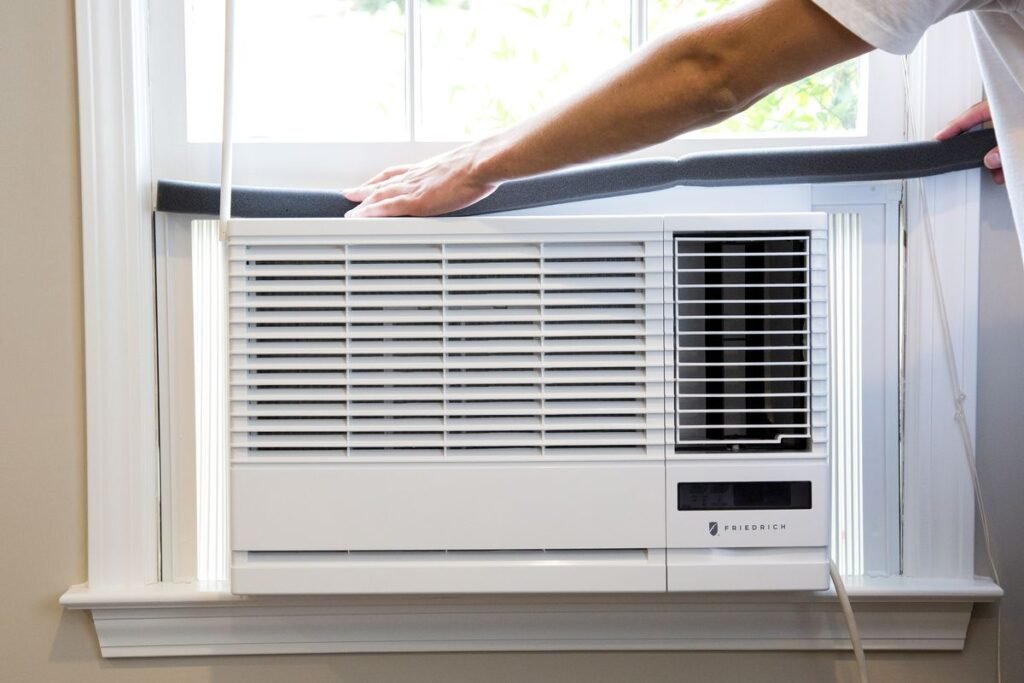
- Foam weatherstripping tape can be purchased from any hardware store.
- Run it around the top, bottom and edges of the window frame where it connects with the AC unit.
- Extend and fully secure the side accordion panels.
- For stubborn gaps, stuff foam pipe insulation or extra tape in them.
A well-sealed unit can feel as if you got 2–3 degrees of additional cooling — without doing anything different inside the AC. For more detailed sealing tips and seasonal prep advice, visit Window AC Maintenance, a dedicated resource for keeping your unit running at its best.
Fix #8 — Check the Thermostat and Fan Settings
Often the issue isn’t dirty parts — it’s simply incorrect settings. Many people don’t set their AC correctly and then think it’s not working.
Common setting mistakes:
| Mistake | What Happens | Fix |
|---|---|---|
| Fan set to “ON” instead of “AUTO” | Fan constantly runs, even when not cooling | Switch to AUTO |
| Temperature set too high | AC doesn’t cool aggressively enough | Lower by 2–3 degrees |
| “Energy Saver” mode always on | AC cycles off too often | Turn off for peak cooling |
| Wrong fan speed | Too low = weak airflow | Set to medium or high |
And ensure that nothing is in front of the unit blocking it — furniture, curtains or boxes will trap cool air and limit its distribution.
Pro tip: In the hottest part of the day, set your thermostat to “COOL” mode and fan to “HIGH.” At night, switch to “AUTO” and a lower fan speed to conserve energy.
Fix #9 — Check for Refrigerant Problems
This is the one fix you might need to call a professional to handle, but it’s still crucial information to have.
Refrigerant is the chemical inside your AC that does the work of cooling air. If your unit has a refrigerant leak, cleaning alone will fail to restore full cooling power.
Signs of low refrigerant:
- The AC never gets properly cold — it just blows slightly cool air
- You hear a hissing or bubbling noise from the unit
- Ice builds up on the copper tubing or evaporator coils
- The unit runs constantly but the room temperature doesn’t drop
What you can do:
- Check for ice on the coils — switch off the AC and leave it to thaw for 1–2 hours.
- Turn it back on — if it cools briefly before failing again, refrigerant may be low.
- Check copper lines for oily residue (indicator of a refrigerant leak).
If you suspect a refrigerant issue, call a certified HVAC technician. According to the U.S. Environmental Protection Agency (EPA), handling refrigerants without proper certification is illegal and can carry significant fines. In many places, handling refrigerant without certification is also dangerous.
Window AC Performance at a Glance
Here is a quick overview of all 9 fixes, their difficulty and estimated time:
| Fix | Difficulty | Time Needed | Cost |
|---|---|---|---|
| Clean/replace air filter | Easy | 10–15 min | $0–$10 |
| Vacuum interior dust | Easy | 15–20 min | $0 |
| Clean evaporator coils | Medium | 20–30 min | $8–$15 |
| Clean condenser coils | Medium | 20–30 min | $8–$15 |
| Straighten bent fins | Medium | 15–20 min | $10–$15 |
| Clear drain pan/line | Easy | 15–20 min | $0–$5 |
| Seal air gaps | Easy | 20–30 min | $5–$15 |
| Check thermostat/settings | Easy | 5 min | $0 |
| Inspect refrigerant | Hard | 30+ min | $100–$300 |
How Often Should You Do Window AC Maintenance?
A schedule means your unit runs smoothly through the entire season.
Monthly (during cooling season):
- Clean the air filter
- Wipe down the front grille
- Listen for strange noises or odors
Every 3 months:
- Vacuum the interior
- Clear the drain pan
- Check window sealing
Once per year (start of season):
- Deep clean evaporator and condenser coils
- Check fins and straighten if necessary
- Check refrigerant performance
- Test all fan and thermostat settings
End of season:
- Clean the entire unit before storing or covering
- Cover the outdoor portion with protective wrap for winter
- If removed, store in a dry, upright position
Signs It’s Time to Replace Instead of Repair
Cleaning and maintenance are great, but sometimes they’re not enough. Here’s when you should think about replacing your window AC:
- The unit is 10+ years old and constantly breaks down
- The cost to repair exceeds 50% of the cost of a new unit
- The refrigerant leaks repeatedly
- The compressor has failed
- Energy bills remain high despite upkeep
Newer window ACs are much more energy-efficient than older ones. Replacing a 12-year-old unit with a new one can reduce cooling costs by 20–40%.
FAQs — Window AC Cleaning & Maintenance Guide
Q: How do I know if my window AC filter needs cleaning? The easiest way to check is to hold the filter up to a light source. If you can’t see light through it easily, it’s time to clean or replace it. A visible gray or black coating on the mesh is another clear sign.
Q: Can I use a garden hose on my window AC? You could lightly spray the outdoor-facing condenser coils with a hose set to gentle. Never spray water directly into the electrical components, controls or vents of your unit.
Q: Why does my window AC smell musty even after cleaning? Musty odors generally come from mold or mildew growing inside the drain pan or on the evaporator coils. Use a diluted bleach solution to clean the drain pan and apply an approved coil cleaner to remove mold from the coils.
Q: Can I run a window AC without a filter? No. Operating without a filter allows dust to settle directly on the evaporator coils. This leads to decreased airflow, ice formation and potential compressor failure. Always run with a clean, correctly fitted filter.
Q: How long should a window AC last with good care? Most window ACs can last 10–15 years with proper maintenance. Without regular cleaning, performance can degrade after 5–7 years and the overall lifespan can be noticeably shorter.
Q: Why are ice forming on my window AC coils? Ice forms when there is insufficient airflow (dirty filter or blocked vents) or when refrigerant is low. Turn off the unit and allow it to thaw, then inspect the filter and airflow. If ice continues to return after cleaning, call a technician to check refrigerant levels.
Q: Should I lubricate my window AC fan with WD-40? No. WD-40 is not a long-term lubricant and can damage plastic components. If the fan motor or bearings require lubrication, add a few drops of electric motor oil, which is made specifically for this purpose.
Q: Does cleaning the AC actually make a difference? Absolutely. A dirty filter alone can decrease cooling efficiency by 15–25%. Cleaning the coils, fins and drain on top of that could restore your unit to near-original performance in a single afternoon.
Wrapping It Up
A window AC that’s struggling isn’t always a sign it needs replacing. Most commonly, the issue is a buildup of dust, a blocked drain, bent fins, or gaps letting in hot air.
This window AC cleaning & maintenance guide gave you 9 clear, actionable fixes you can do yourself — most in less than 30 minutes and with tools you likely already own. First tackle the simplest (filter, vacuum and settings) and progress from there.
With routine upkeep, your window AC will reward you with cool, comfortable air all summer long — and many summers to come.
Stay cool. Stay consistent. Maintenance goes a long way.