
Meta Description: Window AC cleaning & maintenance tips can save you hundreds in repair bills. Discover 9 expert lessons learned the hard way — after real breakdowns.
9 Must-Know Window AC Tips on Cleaning & Maintenance I Wish I Had Before Repairs
Nothing is worse than a window AC unit dying on the hottest day of summer.
I’ve been there. Twice. Both times, a technician arrived, poked around for ten minutes and presented me with a bill that made my stomach drop. The culprit? Neglect. Dirty filters, clogged coils, blocked drains — issues that take almost nothing to prevent and a lot of money to repair.
After those painful experiences, I made it my mission to learn everything about keeping a window AC unit running clean and strong. This is the guide I wish someone would’ve given me before those breakdowns happened.
Whether your unit is shiny and new or ten years old, these nine tips will help you extend its lifespan, lower your energy bills, and keep your home cool without having to deal with unexpected repair costs.
Why People Skip Window AC Maintenance (And Why They Shouldn’t)
In general, people have a “set it and forget it” mentality when it comes to window ACs. You plug it in, point it at your face, and enjoy the cold air. Simple, right?
Not really.
A window AC works hard. It draws in warm air, forces it across cold coils, extracts humidity, and blows cooled air back into your room — over and over, for hours. All that work creates buildup. Mold, algae, bacteria, and grime gradually choke the system.
When that happens, the unit works harder to accomplish less. Your energy bill goes up. The cooling gets weaker. And eventually, something breaks.
The good news? You can maintain it inexpensively in under an hour a few times each year.
Tip #1 — Clean or Replace the Air Filter Every 2–4 Weeks
This is the single most important thing you can possibly do.
Your unit’s first line of defense is its air filter. It traps dust, pet hair, pollen, and other particles before they reach the internal components. As it becomes clogged, airflow decreases. The coils freeze. The compressor strains. Disaster follows.
How to do it:
- Turn off and unplug the unit.
- Remove the front panel (usually snaps off by hand).
- Slide out the filter.
- If it’s reusable, rinse it under warm water. Use a soft brush if needed.
- Allow it to dry thoroughly before reinserting.
- If it’s disposable, swap it out for the correct size.
Window AC filters are usually reusable mesh-style ones. Hold yours up to the light — if you can barely see through it, it needs cleaning now.
Pro tip: Set a phone reminder every 2–3 weeks during peak summer use. It takes five minutes and makes a huge difference.
Tip #2 — Wash the Evaporator and Condenser Coils Every Season
After my first repair bill, the technician pointed to my coils and said they hadn’t been touched in years. He was right. I hadn’t even known that coils needed cleaning.
A window AC contains two sets of coils:
| Coil Type | Location | Function |
|---|---|---|
| Evaporator Coil | Inside (room side) | Absorbs heat from indoor air |
| Condenser Coil | Outside (back of unit) | Releases heat to the outdoors |
Both collect dirt over time. Dirty coils can’t transfer heat properly, which causes the system to run longer and work harder.
How to clean them:
- Unplug the unit completely.
- Loosen dust with a soft brush or vacuum with a brush attachment.
- Apply a no-rinse coil cleaner (available at hardware stores) on the coils.
- Let it foam and drip — it dissolves grease and dirt on contact.
- For the condenser coils (outside), gently rinse with a garden hose on low pressure.
Never use a pressure washer. The fins on coils are thin and bend easily. Bent fins impede airflow just as badly as dirt.
Tip #3 — Use a Fin Comb to Straighten Bent Fins
Speaking of bent fins — this is something almost nobody talks about.
Your coils have aluminum fins that resemble a radiator. They’re thin, closely spaced, and very easy to bend. Some bending over time is normal with even regular use. A blocked spot of fins means less airflow, decreased efficiency, and increased wear on the compressor.
A fin comb is an inexpensive tool (normally less than $10) that slides right between the fins and straightens them back out. You simply select a comb size appropriate to your fin spacing and run it through gently.
Do this once a year during your seasonal cleaning. It’s one of those five-minute jobs that most people don’t bother with — and it really works.
Tip #4 — Clear the Condensate Drain Line Before It Clogs
Here’s what led to my second repair. The condensate drain was completely clogged.
When a window AC pulls moisture from the air, that condensation has to go somewhere. It drips from the evaporator coil, collects in a drain pan, and flows out through a small drain line or hole at the back of the unit.
If that drain becomes clogged — with algae, mold, or debris — water backs up. It can overflow the pan, drip into your home, or worst case, damage electrical components.
Signs of a clogged drain:
- Water dripping from the front of the unit (should drip from the back)
- Musty smell
- Visible standing water at the bottom of the unit
How to clear it:
- Unplug the unit.
- Locate the drain hole (typically at the back bottom).
- Use a pipe cleaner, thin wire, or wet/dry vacuum to clear the blockage.
- Pour a small amount of diluted white vinegar into the drain pan to kill algae and prevent future buildup.
- Do this every 1–2 months during heavy use season.
Tip #5 — Disinfect the Drain Pan to Stop Mold and Odor
The drain pan sits at the bottom of your unit and collects condensation. It’s dark, damp, and warm — an ideal environment for mold, mildew, and bacteria to flourish.
If your AC smells musty when it runs, this is almost always the reason.
Cleaning the drain pan:
- Remove the unit from the window or access the pan through the casing.
- Wipe out any standing water and visible gunk with paper towels.
- Scrub the pan with warm water and a few drops of dish soap.
- Rinse with a 50/50 mix of white vinegar and water to kill mold spores.
- Let it dry before reassembling.
Do this at the start of every cooling season and once mid-season if you run the unit heavily.
Tip #6 — Wipe the Front Grille and Outer Casing
This one seems cosmetic, but it does matter for airflow.
The front grille is where air enters your room. Dust and dirt collect in the slots and restrict airflow. It also makes the unit appear old and dirty, which can push people to abandon cleaning altogether — because “it’s already gross.”
Quick cleaning steps:
- Remove the front grille (most snap off or have two screws).
- Wash it in warm soapy water.
- Use an old toothbrush to scrub dust from the slots.
- Wipe the outer casing with a damp cloth.
- Dry everything before reassembling.
Clean this every 4–6 weeks during summer. It takes ten minutes and makes a marked difference in airflow and air quality.
Tip #7 — Inspect and Seal the Window Installation Every Year
This is one that surprised me when I learned it.
A poorly sealed window installation doesn’t just let hot air sneak in around the edges — it also causes the unit to work harder to maintain your set temperature. That constant overwork eventually leads to compressor problems.
What to check:
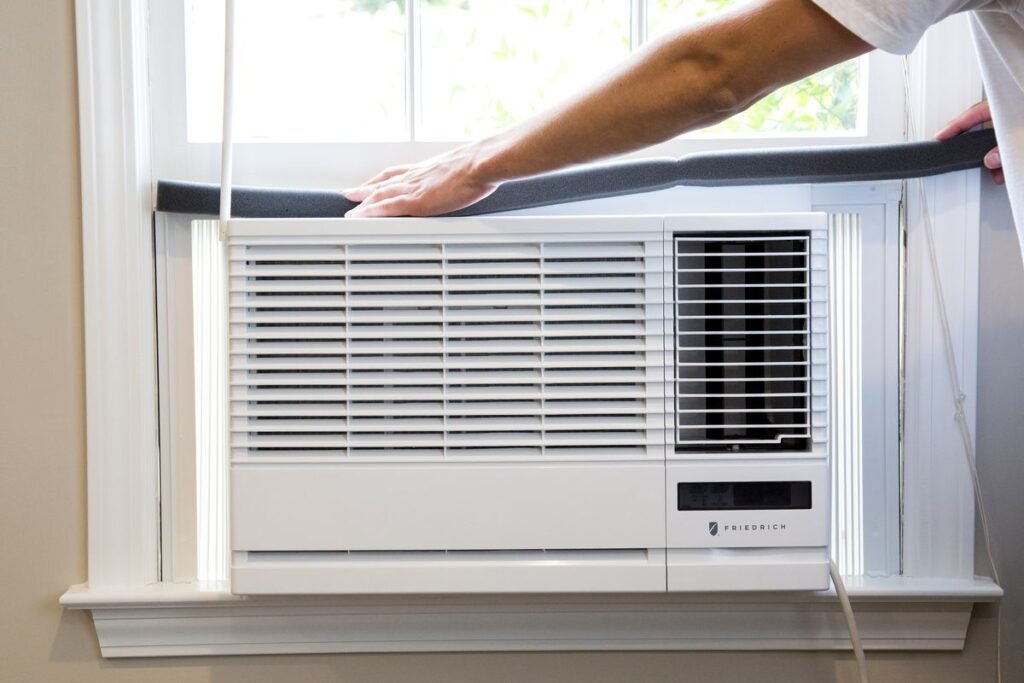
- Look at the foam strips and accordion panels on the sides of the unit.
- Press on the foam — if it’s brittle, compressed flat, or crumbling, it needs to be replaced.
- Check for gaps between the unit and the window frame.
- On the outside, look at where the unit meets the sill. Gaps let rain and insects in.
How to fix it:
- Replace old foam weather stripping with fresh strips (inexpensive at any hardware store).
- Use foam tape or AC window insulation film to seal gaps.
- Make sure the unit is tilted slightly backward (about half an inch) so condensation drains outside, not in.
Performing this check every spring before you install the unit takes 15 minutes and can noticeably reduce your cooling costs. For more in-depth seasonal prep guides, Window AC Maintenance is a great resource to bookmark.
Seasonal Maintenance Schedule at a Glance
Here’s a simple reference chart to keep your maintenance on track:
| Task | Frequency |
|---|---|
| Clean/replace air filter | Every 2–4 weeks (when in use) |
| Clean evaporator & condenser coils | Once per season |
| Straighten coil fins | Once per season |
| Clear condensate drain line | Every 1–2 months |
| Disinfect drain pan | Start of season + mid-season |
| Clean front grille & casing | Every 4–6 weeks |
| Check window seal & weather stripping | Before every spring install |
| Inspect fan blades | Once per season |
| Professional check-up | Every 2–3 years |
Tip #8 — Inspect and Clean the Fan Blades
Your window AC has a blower fan that pushes air over the evaporator coil and into your room. The condenser fan on the outside pulls air across the hot condenser coil.
Both fans accumulate dust and grime over time. A dirty fan blade is unbalanced. An unbalanced blade wobbles. Wobbling puts unnecessary stress on the fan motor bearings. Eventually, the motor gives out — and a replacement is not cheap.
How to inspect the fans:
- Unplug the unit.
- Carefully remove the casing (keep track of screws).
- Look at the fan blades — are they coated in gray dust? Are any blades bent or cracked?
- Wipe each blade with a damp cloth or use a small brush to remove buildup.
- For the squirrel cage blower fan (a cylinder of fins), use a small brush and a vacuum.
Signs your fan has a problem:
- Rattling or clicking sounds during operation
- Reduced airflow even with a clean filter
- Vibrating unit
According to the U.S. Department of Energy, keeping your AC components clean — including fan blades — directly improves efficiency and extends the unit’s lifespan. Catching a dirty fan early costs you nothing. A replacement motor can set you back $100–$200 or more in parts alone.
Tip #9 — Store the Unit Properly in the Off-Season
Most people yank their window AC out at the end of summer, shove it in a closet, and forget about it until next June. This is a mistake.
How you store it directly affects how it performs — and how long it lasts.
Proper storage steps:
- Clean the unit thoroughly before storing (filter, coils, drain pan, and casing).
- Make sure it’s fully dry — storing a damp unit encourages mold growth over winter.
- Cover it with a breathable cover or an old pillowcase (not a plastic bag — plastic traps moisture).
- Store it upright. Laying a window AC on its side can let oil from the compressor flow into the refrigerant lines, causing problems when you restart it.
- If you must lay it on its side during moving, let it stand upright for at least 24 hours before plugging it back in.
- Store it somewhere dry and temperate — not a damp basement or unheated garage with extreme temperature swings.
A well-stored AC unit comes out of storage ready to work. A poorly stored one needs extra cleaning just to be safe — and may have hidden issues from moisture damage.
When to Call a Professional
These nine tips cover everything a homeowner can safely do themselves. But some situations call for a professional.
Call a technician if you notice:
- Ice forming on the coils despite a clean filter and good airflow
- Refrigerant leaks (oily residue near the coils, or the unit blowing warm air despite running)
- Electrical burning smell
- The unit tripping your circuit breaker
- Loud grinding or screeching from the compressor
Refrigerant handling is regulated — it requires a certified technician. Electrical faults are a safety hazard. Don’t DIY these.
A professional tune-up every 2–3 years is worth the cost for units you rely on heavily. They can spot worn capacitors, check refrigerant levels, and clean parts that are hard to reach safely at home.
Most Common Window AC Cleaning & Maintenance Questions
Q: How often should I do a full window AC cleaning? A complete clean — filter, coils, drain pan, and casing — should happen at least once before summer starts and once mid-season if you are using the unit on a daily basis.
Q: Can I use a regular household cleaner on the coils? No. Use a dedicated no-rinse coil cleaner. Regular cleaners can leave residue that damages the coil material or causes corrosion over time.
Q: My AC smells like mildew. What do I do? This will nearly always be the result of mold in the drain pan or on the evaporator coil. Clean both with a vinegar solution and make sure the drain line isn’t clogged.
Q: Is it okay to run my AC without the filter? Never. Without a filter, dust and debris go directly onto the evaporator coil. Coils clog quickly, causing freezing, reduced airflow, and costly damage.
Q: How do I know if my window AC needs refrigerant? If the unit is blowing air but it’s not cold, and the coils are icing over despite good airflow, you may have a refrigerant leak. This requires a certified HVAC technician — it’s not a do-it-yourself fix.
Q: Does cleaning my AC really lower my energy bill? Yes, noticeably. A clean AC unit runs efficiently. A dirty one works harder and longer to reach the same temperature. It has been shown that a clogged filter alone can increase energy consumption by 5–15%.
Q: When is the best time to do window AC maintenance? Spring — just before you install the unit for summer — is the best time for a thorough cleaning. It gives you a fresh start for the season.
Final Thoughts
All the repair work I paid for was preventable.
That’s the frustrating truth I had to accept after my second breakdown. The technician didn’t tell me anything complicated. He simply said: keep it clean, keep the drain clear, and check on it before summer.
These nine window AC cleaning and maintenance tips aren’t difficult. They don’t require special skills or expensive tools. They just need a bit of time and consistency.
Clean the filter every few weeks. Wash the coils once a season. Clear the drain. Check the seal. Store it right. Do those things, and your unit will reward you with years of reliable, efficient cooling.
The best repair is the one you never need.