Meta Description: Window AC cleaning & maintenance hacks can slash your energy bills fast. Discover 8 powerful, easy-to-follow tips to keep your unit running cool and efficient.
8 Mighty Window AC Cleaning & Maintenance Tricks to Consume Lesser Power
Summer heat hits hard. And when your window AC is working extra hard, so does your energy bill.
The good news? You don’t have to bother a technician each time your unit loses its cool. With the proper window AC cleaning and maintenance habits, you can improve performance, help prolong the life of your unit, and lower energy bills — all by yourself.
This guide has distilled 8 proven hacks that actually work. These tips will make a difference whether your AC system is brand new or five years old.
Let’s get into it.
Why Your Window AC Becomes Less Efficient Over Time
Ahead of diving into the hacks, it’s helpful to know why air conditioners become inefficient in the first place.
Every window AC pulls air from your room, cools it and pushes it back. As it does so, it also draws in dust, pet hair, pollen and moisture. Over weeks and months, that buildup clogs filters, blocks coils and makes the motor exert more energy.
The more a motor has to work, the more electricity it consumes.
According to the U.S. Department of Energy, a dirty or unmaintained air conditioner can use up to 15 percent more energy than a clean, well-maintained unit. That doesn’t sound like much — until you see it reflected in three or four months of summer electric bills.
A fix exists that’s simpler than most think. It only requires regular cleaning and a couple of smart maintenance practices.
What You’ll Need Before You Begin
Before you tackle any maintenance task, have these basic supplies on hand:
| Supply | Purpose |
|---|---|
| Soft-bristle brush | Clean fins and coils |
| Mild dish soap | Wash the filter |
| Spray bottle with water | Rinse components |
| Fin comb | Straighten bent aluminum fins |
| Vacuum with brush attachment | Remove loose dust |
| Microfiber cloths | Wipe surfaces dry |
| Screwdriver | Remove front panel |
| Coil cleaner spray (optional) | Deep clean evaporator coils |
None of these are expensive. Most already sit in your home.
Hack #1 — Clean Your Air Filter Every 2–4 Weeks
This is the most important thing you can do.
Your air filter is the first line of defense for your AC. It works by trapping dust so it does not reach the internal parts. If the filter becomes clogged, air cannot pass through it properly. The unit must work harder to draw in air, burning up energy and slowing down room cooling.
How to Clean It the Right Way
Step 1: Completely switch off and unplug your AC unit.
Step 2: Remove the front panel. On the vast majority of window units, it just snaps off or attaches with one or two screws.
Step 3: Slide out the filter. It generally appears as a thin mesh or foam rectangle.
Step 4: Gently tap it against a trash can to knock off any loose dust.
Step 5: Rinse under warm running water. If it’s greasy or super dirty, use a little drop of dish soap and scrub lightly with your fingers.
Step 6: Allow it to air dry completely — never replace a wet filter.
Step 7: Insert it back in and replace the panel.
Clean filters can enhance efficiency by 5 to 10% for each cooling cycle. It’s quick — under 10 minutes, and free.

Hack #2 — Straighten Evaporator and Condenser Fins
Check out the sides and back of your window AC unit. You’ll see rows of thin strips of aluminum called fins. These fins help transfer heat. When they bend or crush — from bumps, cleaning pressure or general usage — airflow becomes blocked.
Restricted airflow means less cooling capability, and more energy usage.
Fixing Bent Fins Is Simple and Quick
A fin comb is a small, cheap implement you can purchase at any hardware store. It glides across the fins, delicately bending them back into place.
Slowly run the comb from top to bottom. Don’t force it. If a section is badly damaged, work it in incremental stages over several passes instead of one hard push.
Flat fins let air flow through uniformly. This directly improves heat exchange, so your unit cools quicker and uses fewer watts to do it.
Hack #3 — Clean the Evaporator Coils Deeply Once Per Season
Behind the filter are the evaporator coils. They’re what really cool the air. If dust and dirt accumulate on the coils, they are not able to absorb as much heat. The result? Longer run times, and bigger bills.
Step-by-Step Coil Cleaning
Step 1: Remove the filter and front panel as discussed in Hack #1.
Step 2: Gently remove loose dust from the coils with a vacuum fitted with a soft brush attachment. Work with the direction of the fins — never across them.
Step 3: Spritz coil cleaner (available at hardware stores) directly onto the coils. These cleaners foam and self-rinse — no need to rinse with water.
Step 4: Allow the foam to sit for the amount of time specified on the bottle (typically 10 to 15 minutes). This will loosen up dirt, which then drips into the drain pan.
Step 5: Use a dry microfiber cloth to wipe away any residue.
Do this at the beginning of every cooling season — and midway through, if you use the AC heavily.
Hack #4 — Clear the Drain Pan and Drain Line
Here’s one that most people totally ignore — the drain pan.
Your AC dehumidifies the air when it cools. That moisture drips into a small pan at the bottom of the unit and is expelled through a drain hole or tube. When that drain becomes clogged — by algae, mold or debris — water backs up. A clogged drain can damage the unit itself, affect its efficiency, or even lead to water leaks inside your home.
Cleaning the Drain Pan
Step 1: Unplug the unit and pull out the bottom tray (the location will be shown in your owner’s manual).
Step 2: Remove residual water with a small sponge or cloth.
Step 3: Combine one part bleach and ten parts water in a spray bottle. Spray the pan thoroughly.
Step 4: Allow it to sit for five minutes, then wipe clean.
Step 5: Check the drain hole. If it appears clogged, use a thin wire or pipe cleaner to gently clear it.
Do this process every 4–6 weeks during peak use. Cleaning the drain pan ensures the unit can run efficiently and keeps mold at bay.
Hack #5 — Seal the Gaps Around Your Window Unit
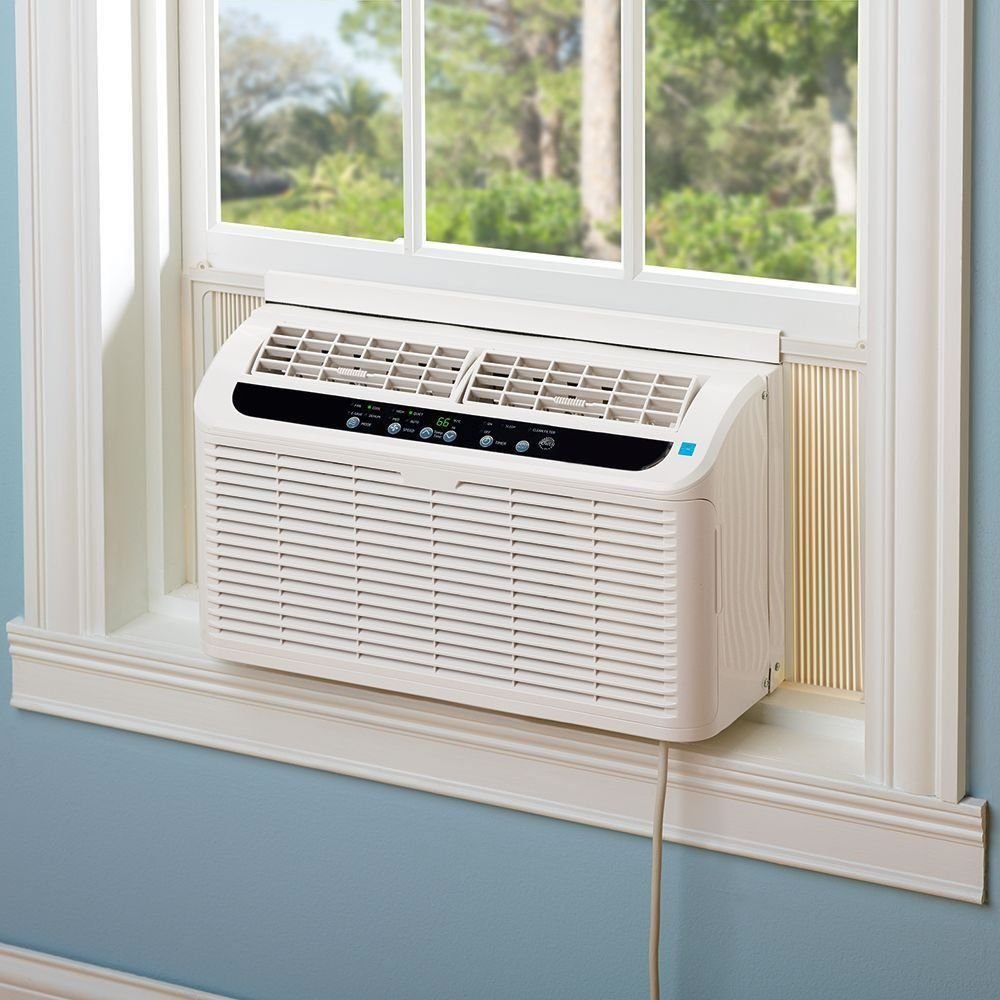
You could have the cleanest AC in your building — but if there are gaps around the unit where it sits in the window, you’re leaking cool air and sucking in hot outside air all day long.
This causes your AC to run longer than it needs to.
How to Check and Seal Gaps
Gently run your hand around the sides, top and bottom of the unit where it connects with the window frame. If you sense warm air entering, you have discovered a leak.
Fix it with:
- Foam weatherstripping tape — press it along the window frame wherever there are gaps
- AC side panel insulating covers — these slip over the accordion-style side panels that are included with your unit
- Rope caulk — a temporary, removable caulk you can push into cracks for the season
Sealing gaps can reduce the cooling load on your unit dramatically. This one fix alone can reduce energy use by up to 10% in older window installations.
Hack #6 — Clean the Condenser Coils on the Outside of the Unit
Most window AC guides are all about the inside. But the condenser coils — located on the back of the unit, facing outside — also become dirty. They’re exposed to outdoor dust, pollen, leaves and even insects.
The job of the condenser is to release heat from your home into the outside air. When it is dirty, it does not release heat well. Your compressor has to work longer and harder to make up for it.
Outdoor Coil Cleaning (Safe Method)
Step 1: Unplug the unit. If possible, remove it from the window and take it outside to work on.
Step 2: Wipe down the fins using a vacuum or soft brush to remove as much visible debris as possible.
Step 3: Using a gentle spray setting, rinse the fins from the inside out using a garden hose. This pushes debris outward instead of deeper in.
Step 4: Let it dry completely (no less than 30 to 45 minutes) before reinstalling.
Never use a high-pressure nozzle — it will bend the fins and damage the coils.
Hack #7 — Set the Fan Speed and Temperature Wisely
It’s not a cleaning hack — but it is a maintenance habit with huge potential to minimize wear and energy consumption.
The average person just runs their AC on full blast all day or turns it on and off rapidly. These habits waste energy and put additional strain on the motor and compressor.
The Smarter Approach
| Situation | Recommended Setting |
|---|---|
| Room is very hot (arriving home) | High fan, low temp briefly |
| Maintaining comfort | Medium fan, moderate temp (74–76°F) |
| Sleeping | Low fan, slightly higher temp (76–78°F) |
| Room is empty | Turn off or use timer function |
Key tip: Every degree you increase your thermostat setting saves around 3% on your cooling costs. Turning up the dial to 76°F rather than 70°F can add up across an entire summer.
Also, using the “Auto” fan mode (rather than always-on) means the fan only runs when cooling is actively needed. That alone extends motor life and cuts electricity use.
Hack #8 — Do a Full Tune-Up Before and After Every Season
This is your AC’s annual health check. Taking 30 minutes before you start using it in the summer — and again when you shut it down in the fall — can prevent big problems and keep efficiency high.
Pre-Season Checklist
- ✅ Clean or replace the air filter
- ✅ Inspect and clean both sets of coils
- ✅ Check and clean the drain pan
- ✅ Straighten any bent fins
- ✅ Inspect the power cord for breaks or damage
- ✅ Test all fan speeds and temperature settings
- ✅ Check the window seal for gaps
- ✅ Wipe down the exterior cabinet
End-of-Season Checklist
- ✅ Clean the filter before storing
- ✅ Run the unit on fan-only mode for 30 minutes to dry out internal moisture
- ✅ Cover the back exterior with an AC cover to protect from winter debris
- ✅ Store in a dry, upright position if removing for the winter
Units that receive appropriate seasonal care consistently outlast neglected units by 3 to 5 years or more.
How Often Should You Perform Each Task?
Here’s a quick reference chart:
| Maintenance Task | Frequency |
|---|---|
| Clean air filter | Every 2–4 weeks (summer) |
| Inspect window seal | Monthly |
| Clean drain pan | Every 4–6 weeks |
| Clean evaporator coils | Once per season |
| Clean condenser coils | Once per season |
| Straighten fins | Once per season |
| Full seasonal tune-up | Twice a year |
Maintaining this schedule will virtually eliminate surprise breakdowns in the middle of a heat wave.
Energy Savings: How the Numbers Shake Out
Here’s a realistic breakdown of how much each hack can save you on energy costs over an entire summer:
| Hack | Estimated Energy Savings |
|---|---|
| Clean air filter | 5–10% |
| Seal window gaps | 5–10% |
| Clean evaporator coils | 5–8% |
| Clean condenser coils | 5–8% |
| Smart temperature settings | 3–6% per degree adjusted |
| Clear drain and airflow paths | 2–4% |
| Straighten fins | 2–5% |
| Seasonal tune-up (combined effect) | Up to 20–25% total |
These numbers are cumulative. If you consistently follow all 8 hacks, it is realistic to achieve 15–25% lower energy consumption from your window AC, compared to a neglected unit.
Common Mistakes That Kill Your AC’s Efficiency
Avoid these habits that quietly drain your energy bill:
Running on full blast constantly — It strains the compressor more and doesn’t cool the room any faster than a lower setting does.
Blocking airflow around the unit — When furniture, curtains or other objects are placed in front of an AC vent, it limits airflow and forces the unit to work harder.
Neglecting the drain pan — Even a bit of algae or mold in the drain pan can impact air quality and over time cause damage to the unit from the inside.
Overlooking a filter clean because it “doesn’t look dirty” — Filters catch particles that are invisible to the naked eye. If it’s been 4 weeks, clean it anyway.
Using an AC that is the wrong size for the room — An undersized unit runs all the time and still can’t cool the room. An oversized one short-cycles, wastes energy and doesn’t dehumidify effectively.
FAQs About Window AC Cleaning & Maintenance
Q: How often should I perform a full window AC cleaning?
A thorough cleaning — including coils, filter, drain pan and fins — should be done at least once per cooling season. If your unit runs a lot or if you live in a dusty climate, aim for twice per season.
Q: Can I use a regular household cleaner on AC coils?
No. Household cleaners can eat away at aluminum fins and leave a residue that impedes airflow. Use a no-rinse coil cleaner spray designed for that specific purpose.
Q: My AC smells musty. What does that mean?
A musty odor is most often an indication of mold or mildew. A dirty drain pan, a clogged drain line or moisture trapped in the filter are the likely culprits. Make sure all three are clean and let the unit run in fan-only mode for some time to dry everything out.
Q: Is it safe to clean a window AC without taking it out of the window?
Yes — for filter cleaning, drain pan maintenance and coil spraying, you can do it all in place. Removing the unit is not required for cleaning the condenser coil, but it is easier and more thorough.
Q: At what temperature should you set a window AC to save energy?
The Department of Energy suggests 78°F (26°C) when you’re home and active, and higher when you leave or sleep. Every degree counts — raising the setting by 1°F saves around 3% on energy use.
Q: How can I tell whether my window AC needs professional servicing?
Signs it’s time to call in a technician include: the unit blows warm air even after cleaning, the compressor makes loud clicking or grinding sounds, there’s ice forming on the coils, or the unit is continually tripping the circuit breaker.
Q: Is it helpful to cover the outside of the unit in winter?
Yes. An outdoor AC cover prevents debris, insects and moisture from getting into the condenser coils during the off-season. It’s a small investment that prevents rust and blockages when you start it up again in spring.
Wrapping It Up
Your window AC doesn’t have to be a power-hungry machine.
With regular window AC cleaning and a few wise maintenance habits, you can keep your unit running efficiently all summer — without bringing anyone in or spending much money at all.
Start with the filter. Check the drain pan. Seal the gaps. Clean the coils. These aren’t complicated jobs. They take 10 to 30 minutes and pay for themselves in reduced electricity bills within weeks.
The longest-lasting and cheapest-to-operate units aren’t the newest or priciest. They’re the ones that get consistent, regular care.
Choose one hack from this list and do it today. Then work through the rest. Your energy bill — and your AC — will appreciate it.