Meta Description: Window AC service routine cleaning, & maintenance guide to increase the longevity and energy savings for your air conditioning unit. Here’s 6 Powerful Routines Every Home Needs.
6 Essential Window Air Conditioning Cleaning & Maintenance Routine For Every Home
You switch on your window AC, and instead of cool, fresh air — you get a musty odor, lackluster airflow, and an inflated electricity bill. Sound familiar?
Most of us use our window AC unit until it doesn’t work. But with a little regular care, they will flourish. With the help of the right window AC cleaning & maintenance guide, you can keep your unit running strong through the summer — and plenty more summers to come.
So be sure to check out this guide breaking down 6 simple, yet highly effective routines every homeowner needs to implement. No technical skills needed. It takes a little time and the right moves.
Let’s get into it.
But Why Should You Actually Maintain Your Window AC Regularly?
Before diving into the routines, let’s quickly refresh on why this even matters.
A dirty and badly maintained window AC unit:
- Does the same job using more electricity
- Produces weaker, warmer airflow
- Disperses dust, mold, and allergens throughout your room
- Causes natural wear-and-tear, costly repairs, or premature replacement
- Can lead to water leaks and moisture damage in your walls
According to the U.S. Department of Energy, one dirty or clogged AC filter can reduce efficiency by 5% to 15%. That accumulates quickly on your monthly bills.
The good news? The majority of maintenance tasks take less than 30 minutes and cost next to nothing.
Before You Start: What You’ll Need
Here’s a quick list of tools and supplies you’ll want to have on hand:
| Item | Purpose |
|---|---|
| Screwdriver (flathead & Phillips) | Remove panels and grilles |
| Soft brush or old toothbrush | Scrub fins and small parts |
| Vacuum with brush attachment | Remove dust and debris |
| Mild dish soap + warm water | Clean filters and housing |
| Spray bottle | Apply cleaning solutions |
| White vinegar | Kill mold and bacteria |
| Fin comb | Straighten bent AC fins |
| Microfiber cloths | Wipe surfaces dry |
| Gloves & face mask | Personal protection |
No fancy chemicals needed. Common household items do the trick.
Routine #1 — Clean the Air Filter Once Every 2 to 4 Weeks
This is the most important maintenance you can perform.
The air filter adds a layer of protection from dust, pet dander, pollen, and other particles before they get into your room. Over time, it becomes clogged — and that makes your AC work harder to push air through.
Step by Step: How to Clean the Filter
- Completely turn off and unplug your window AC unit.
- Take off the front panel (it often pops off or has a few screws).
- Pull out the filter — it’s a sliver of mesh screen.
- Take it outside and tap it lightly to loosen any loose dust.
- Rinse it under warm running water. For stubborn grime, add a couple of drops of dish soap.
- Let it dry completely in the air — never put a wet filter back inside.
- Install and reconnect the unit.
Filter Cleaning Schedule
| Frequency of AC Usage | How Often to Clean Filter |
|---|---|
| Daily (in hotter locations) | Every 2 weeks |
| A few times a week | Every 3–4 weeks |
| Now and again | Once a month |
| You own pets or have allergies | Every 1–2 weeks |
Pro tip: Hold the filter up to a light. If you can’t see light through it clearly, then clean — or replace it.
Some filters are not washable. Check your owner’s manual. Disposable filters typically range from $5 to $15 each and need to be replaced every 1 to 3 months, depending on usage.
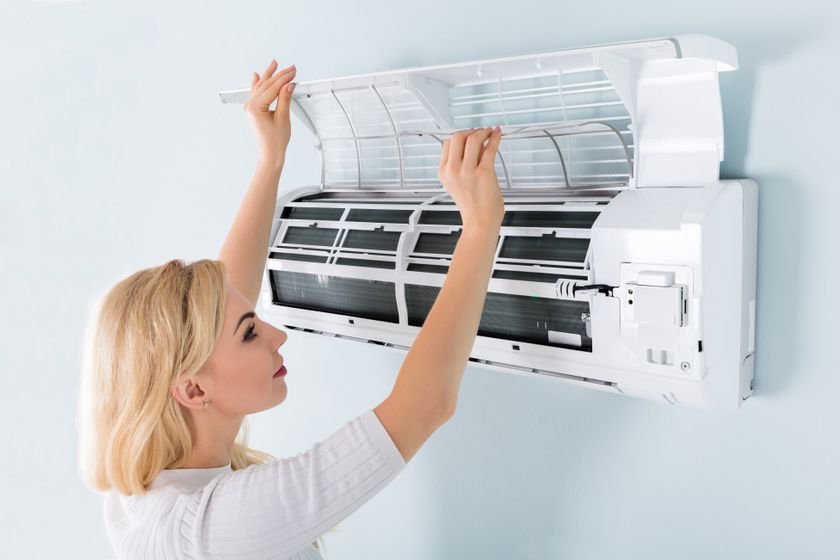
Routine #2 — Deep Clean the Evaporator and Condenser Coils Every Other Season
Coils are the core components of your AC system. They are responsible for absorbing heat and releasing it outdoors.
When coils become coated with dust and grime, they lose the ability to transfer heat. Your unit ends up running longer and harder — which increases costs and decreases AC life.
The Difference Between Evaporator and Condenser Coils
| Coil Type | Location | Function |
|---|---|---|
| Evaporator Coils | Inside (front of unit) | Absorb heat from your room |
| Condenser Coils | Outside (back of unit) | Release heat into outside air |
Both should be cleaned — at the beginning of cooling season, and ideally again in mid-summer.
How to Clean AC Coils
- Turn off the unit and, if you can, remove it from the window.
- Unfasten the panels to take off the outer casing.
- Gently dislodge any dust on the coil fins with a soft brush.
- Using a brush attachment, vacuum away the loosened debris.
- Spritz the coils with a no-rinse coil cleaner (available at hardware stores) or a solution of warm water and several drops of dish soap.
- Allow to sit for 5–10 minutes, then wipe down with a damp cloth.
- Let everything dry before reassembling.
Important: Be gentle. The fins are both thin and flexible.
Routine #3 — Align Bent Fins for Smooth Airflow
If you look closely at your AC coils, you’ll notice rows of thin metal strips called fins. These fins allow air to pass freely over the coils.
Over the years, they can become bent due to bumps, pressure, or scrubbing while cleaning. Even a slight bend in the fins can restrict airflow and efficiency.
Why Bent Fins Are a More Serious Problem Than You May Think
Bent fins restrict airflow along the coils. When airflow is restricted:
- The AC does not cool air as effectively
- The compressor must run harder (and consume more energy)
- The unit can freeze up — ice forming on the coils
- Your power bill creeps ever higher
How to Fix Bent Fins
Use a fin comb — an inexpensive tool (usually less than $10) specifically built for that job. It glides between the fin rows and gently straightens them.
Lightly pull the fin comb from top to bottom. Don’t force it. Work slowly.
If you don’t have a fin comb, a butter knife or thin plastic card will work in a pinch — but be mindful that you don’t cause more damage.
Check this every time you deep clean the coils.
Routine #4 — Clean Your Drainage System to Avoid Leaks and Mold
Here’s something that most people don’t know: window AC units produce a ton of water.
When warm air passes over the cold coils, condensation forms — just like a glass of cold water on a hot, humid day. The water drips into a drain pan and exits through a drain hole or tube.
When that drainage system becomes plugged, water spills over. That leads to:
- Water dripping inside your room
- Mold and mildew forming in the drain pan
- Musty smells coming from your AC
- Possible wall or floor damage
How to Clean the Drain Pan and Drain Hole
- Access the drain pan (typically found at the bottom of the unit).
- Pour out any standing water.
- Scrub the pan with warm water mixed half-and-half with white vinegar. The vinegar acts as a natural way to kill both mold and bacteria.
- Use a thin brush or pipe cleaner to clear anything out of the drain hole.
- Rinse the pan, dry it, then put it back together.
Signs Your Drain System May Need Attention
| Warning Sign | What It Probably Means |
|---|---|
| Water leaking inside | Drain hole is clogged or pan is overflowing |
| Musty, moldy smell | Mold is growing in the drain pan |
| Ice forming on coils | Airflow + drainage issue |
| Gurgling, bubbling noises | Partial blockage in drain line |
During heavy-use seasons, check the drain system at least once a month.
Routine #5 — Clean and Inspect the Exterior Housing and Vents
The exterior of your unit takes a beating. Rain, dust, insects, leaves, and debris all accumulate over time on the housing and external vents.
Dirty vents hinder the airflow that your condenser relies on to expel heat. And a cracked housing can allow moisture or bugs inside.
Outside Cleaning Checklist
Here’s what to examine and clean externally:
- Exterior grille/vent slots — Vacuum or brush debris away
- Back fins (condenser side) — Remove debris, foliage, or blockage
- Top and sides of casing — Clean with a damp cloth
- Window seal and frame — Look for cracks where air or moisture could get in
Don’t Forget the Window Seal
The foam seal that surrounds your window AC unit is easy to overlook — but it makes a big difference.
A poor seal means:
- Hot outside air leaking into your room
- Your AC working much harder than it should
- Higher energy bills
For more detailed tips on sealing and protecting your unit year-round, check out Window AC Maintenance — a great resource dedicated entirely to keeping your window AC running at its best.
Inspect the foam seal each season. If it’s torn, compressed, or has bits missing, replace it. Replacement foam seal kits are inexpensive and easy to find at hardware stores.
Seasonal Exterior Maintenance Schedule
| Season | What to Do |
|---|---|
| Spring (before use) | Full exterior clean and seal inspection |
| Summer (monthly) | Quick debris check & vent clearing |
| Fall (before storage) | Full clean, dry thoroughly before covering |
| Winter (during storage) | Use AC cover to protect from elements |
Routine #6 — Properly Winterize and Store Your Unit
If you live in an area with cold winters, your window AC goes unused for months at a time. Storing it properly makes a big difference in its effectiveness next year.
Improper storage leads to:
- Accumulation of dust and moisture inside the unit
- Pest damage (rodents love warm, dark places such as idle AC units)
- Rust and corrosion
- Mold growth over winter
The Proper Way to Winterize Your Window AC
Option A: Remove It From the Window
This is the best option if possible.
- Unplug it and gently take the unit out of the window.
- Clean it completely (filter, coils, drain pan, housing).
- Give it time to air out completely — at least 24 hours.
- Put it back in its original box or wrap it up in a moving blanket.
- Store it in a dry indoor area (basement, closet, or garage).
- Store it standing up — never lay an AC unit on its side, as this could ruin the compressor.
Option B: Keep It in the Window
If removal isn’t practical:
- Give the unit a thorough cleaning before cold weather arrives.
- Put an all-weather AC cover on the outside to block wind, rain, and ice.
- Seal around the unit from inside with foam strips.
- Block the interior vents with foam or a draft stopper.
Pre-Storage Final Checklist
- ✅ Filter cleaned or replaced
- ✅ Coils cleaned and dried
- ✅ Drain pan empty and clean
- ✅ Housing wiped down
- ✅ Unit completely dry before storing
- ✅ Stored upright in a dry area
The Ultimate Window AC Maintenance Calendar
Here’s a quick-reference schedule to help you stay on track with all 6 routines throughout the year:
| Task | How Often |
|---|---|
| Clean the air filter | Every 2–4 weeks |
| Clean evaporator & condenser coils | Twice a year |
| Check and straighten fins | Every coil cleaning |
| Clean drain pan and drain hole | Monthly during use |
| Clean exterior vents and housing | Monthly during use |
| Inspect window seal | Every season |
| Full winterization and storage | Once a year (fall) |
Print this out and pin it inside a cabinet. Future you will be grateful.

Common Window AC Problems and Their Likely Causes
| Problem | Likely Cause | Routine That Fixes It |
|---|---|---|
| Low airflow | Clogged filter or bent fins | Routine #1 & #3 |
| Warm air blowing | Dirty coils | Routine #2 |
| Water dripping inside | Clogged drain pan | Routine #4 |
| Musty or bad smell | Mold in pan or filter | Routine #1 & #4 |
| High electricity bills | Dirty coils, clogged filter | Routine #1 & #2 |
| Ice on coils | Restricted airflow or drainage | Routine #1, #3 & #4 |
| Noisy operation | Debris inside or loose housing | Routine #5 |
Window AC Cleaning & Maintenance — FAQs
Q: How often should I deep clean my window AC? At a minimum, a complete deep clean — coils, drain, and housing included — should be done twice yearly: once before summer and again at the end of that season before any long-term storage.
Q: Can I clean my window AC with a pressure washer? Not a good idea. High-pressure water can twist fins and push moisture into electrical parts. Use a garden hose on the gentlest setting for the condenser coils, or a damp cloth for most parts.
Q: My window AC smells like mold. Is it safe to use? Not until you clean it. Mold buildup in AC units is blown into the air of your room every time the unit operates. Immediately clean the filter, drain pan, and coils with a vinegar solution. If the odor remains, mold may be embedded deeper inside and a professional cleaning might be required.
Q: What happens if I never clean my window AC? The unit will operate less efficiently, consume more electricity, yield bad air quality, and ultimately fail early. Neglected units also turn into breeding grounds for mold, bacteria, and dust mites.
Q: Is it beneficial to run my AC in “fan only” mode at times? Yes! Using it on fan-only mode for 15–20 minutes before turning it off will help dry out moisture inside the unit and reduce mold growth.
Q: Can I clean the coils without removing the unit from the window? Yes, for a basic cleaning. Remove the cover panel to expose the front coils. For a thorough clean of the condenser coils in the back, it’s easier (and better) to take the unit out.
Q: How long do window ACs usually last? Well-maintained window ACs can last 10 to 15 years. A neglected one would break down in five years or less.
Q: Can I leave my window AC in the window all winter with just a cover? It’s not a great solution, but it works if removal is not an option. Use a solid exterior cover and seal any openings from inside to keep out cold drafts and moisture.
Wrapping It All Up
A window AC is a simple machine — at least if you treat it that way.
These 6 window AC cleaning & maintenance guide routines are not difficult. They don’t require special tools or expert knowledge. What they do need is consistency.
Clean the filter regularly. Take care of the coils. Keep the drain clear. Fix bent fins. Clean the outside. Store it properly. That’s really all it takes.
Do those things, and you should be rewarded with years of cool, efficient, clean airflow — and fewer surprise repair bills along the way.
Start with Routine #1 today. No joke — go check your filter this very second. You may be surprised at what you discover.